Tire Tread: The Penny Test and When to Replace Your Tires
A penny, a quarter or a simple gauge shows how much tread you have left. Here's what 2/32" means, why experts say replace sooner and what wear reveals.
By AutoDex Team, Newsroom · 2026-10-12
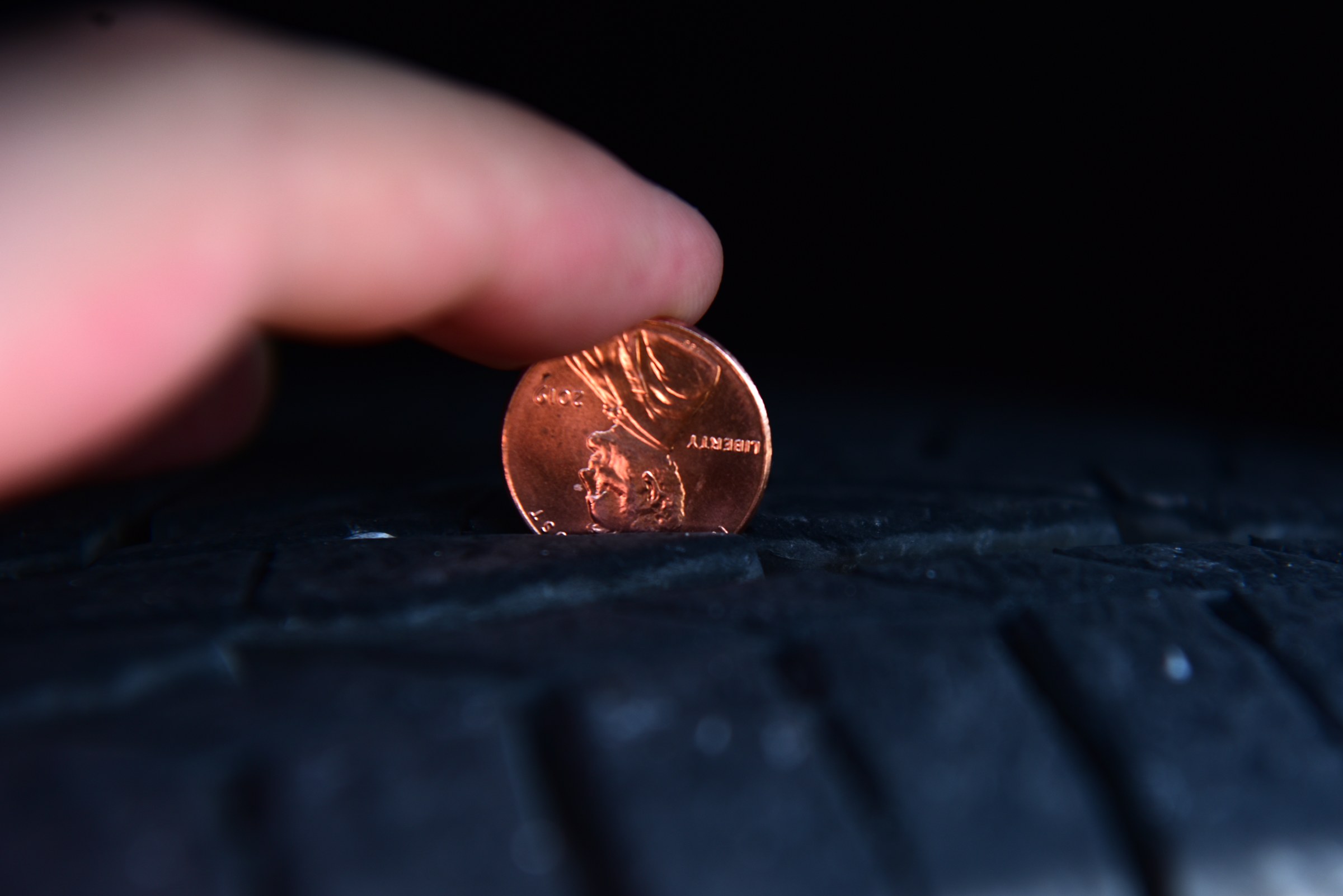
Tread is the only part of your car that touches the road, and it wears away so slowly that most drivers never notice. The grooves do real work. They channel water, slush and snow out from under the tire so the rubber can grip the pavement. As they get shallower, that job gets harder, especially in the rain.
The good news is that checking tread takes about a minute per tire, and the tools fit in your pocket.
How to check tread depth
U.S. tread depth is measured in 32nds of an inch. According to Bridgestone, new tires typically start at 10/32" or 11/32", and some truck, SUV and winter tires start deeper. NHTSA recommends checking tread at least once a month, when you check tire pressure.
There are four common ways to check:
- The penny test. Place a penny in a main groove with Lincoln's head pointing down and facing you. If you can see the top of his head, NHTSA says it's time to replace the tire. The distance from the penny's edge to the top of Lincoln's head is about 2/32".
- The quarter test. Do the same with a quarter. The distance from the rim to the top of George Washington's head is about 4/32", according to Consumer Reports. If you can see all of his head, Consumer Reports says it's time to start shopping for new tires.
- Tread wear indicator bars. Every tire sold in the U.S. is required to have these small raised bars molded into the bottom of the grooves at 2/32", NHTSA explains. When the surrounding tread is worn down level with a bar, the tire is due for replacement.
- A tread depth gauge. Consumer Reports suggests buying one at an auto parts store. Push the probe into a main groove and read the depth directly, so you don't have to judge coins by eye.
Whatever method you use, check several spots across and around each tire. Bridgestone and Pirelli both advise replacing a tire if any area fails, even if other areas still have more tread. Pay close attention to the inner and outer edges, which are easy to miss.
What 2/32" actually means
Two thirty-seconds of an inch is about 1.6 millimeters, and it's the point at which NHTSA says tires are no longer safe and should be replaced. Federal standards require the tread wear indicators to sit at that depth, a level NHTSA says it chose because early studies showed a tire rapidly loses traction once tread is worn to 2/32".
It's also the legal minimum for passenger vehicles in many states, but not a single national rule. NHTSA notes that states, not the federal government, have the authority to enforce when worn tires must come off the road, and state laws differ in their limits and in how depth is measured. Michigan, for example, sets 2/32" for passenger cars and vehicles under 10,000 pounds, but 4/32" on the front tires of vehicles weighing 10,000 pounds or more. Check your own state's vehicle code or inspection rules for the exact standard.
Fleet managers have one more rule to know. For commercial motor vehicles, federal rules (49 CFR 393.75) require at least 4/32" on the front tires of buses, trucks and truck tractors, and at least 2/32" on other tires.
Why many experts say replace sooner
Reaching 2/32" means a tire is worn out. It doesn't mean the tire was performing well right up to that point. Traction on wet and snowy roads drops well before then.
- Consumer Reports advises starting to shop for new tires at 4/32" and replacing them before they reach 2/32". In CR's reporting, NHTSA has found that by the time tread is down to 4/32", tire wear plays a measurable role in crashes.
- AAA testing, reported by Consumer Reports, found that driving on wet roads on tires with 4/32" of tread could increase a passenger car's stopping distance by up to 87 feet compared with new tires.
- Tire Rack recommends replacing tires no later than 4/32" for wet-road traction. In its wet braking tests, summarized by MotorWeek, stopping distances grew sharply as tread wore from new to 4/32" and again to 2/32".
- For snow, Tire Rack has suggested considering replacement at about 6/32", because the grooves need enough depth to pack in snow and release it as the tire rolls, according to a 2009 Tire Rack release. Consumer Reports advises drivers in snowy areas to make sure they still have at least 4/32" in the middle of winter, which may mean replacing tires a bit earlier than in milder seasons.
Passing the penny test tells you a tire has reached the end of its life. Passing the quarter test tells you it's time to start shopping. If you notice the car losing grip or hydroplaning on wet pavement, Consumer Reports says replacement may be due even if the tires haven't hit 2/32".
What uneven wear is telling you
Tires that wear unevenly are often pointing to a problem elsewhere on the car. Michelin and Bridgestone link common patterns to these likely causes:
- Center wear. The middle of the tread is more worn than the edges. Michelin associates this with chronic overinflation.
- Wear on both edges. Both shoulders are worn and the center looks healthier. This typically points to chronic underinflation.
- Wear on one edge. Only the inner or outer shoulder is worn down. This usually signals an alignment problem, often camber.
- Feathering. Tread ribs feel smooth on one side and sharp on the other. Bridgestone says this is often caused by alignment settings such as excessive toe.
- Cupping or scalloping. Scooped-out spots repeat around the tread. Bridgestone links this to worn shocks, struts or other suspension and steering parts, as well as alignment or balance problems.
Treat these as clues, not a diagnosis. Patterns can overlap, and more than one cause can be at work. If you see uneven wear, have a tire shop or mechanic inspect the tires, alignment and suspension. As Michelin points out, fixing the cause stops the pattern from getting worse, but it won't undo the wear already on the tire. If the cause isn't fixed, it can wear out the replacement tires the same way.
While you're looking, check for the damage NHTSA lists as reasons to stop using a tire: cuts, cracks and bulges in the sidewall or tread.
Tire age and the DOT date code
Tread isn't the only clock running. Rubber ages even on tires that see little use, and NHTSA says older tires are more prone to failure.
To find a tire's age, look on the sidewall for the letters "DOT" followed by the Tire Identification Number. The last four digits are the week and year the tire was made. A code ending in 3520, for example, means the 35th week of 2020. NHTSA notes the full number may appear on only one side of the tire, so check both.
Guidance on age varies. NHTSA says some vehicle and tire manufacturers recommend replacing tires that are six to 10 years old, regardless of tread. Michelin recommends a yearly professional inspection once tires have been in use for five years, and replacement 10 years after the date of manufacture, spares included. Your owner's manual or tire maker may set a different limit, so check what applies to your tires.
Keep a record
Tread checks are more useful when you can compare them over time. In the AutoDex Logbook, you can add a Tire Rotation record with the date, mileage and shop, and log a new set of tires when you buy them. The next time you measure, you'll know how many miles those tires have covered and whether they're wearing faster than expected. Fleet managers can use the same history to compare wear across vehicles.
Tread and pressure go together, since underinflation is one of the causes of uneven wear. If the tire pressure light comes on, our dashboard warning lights guide explains what a steady or flashing light means and what to do next.
Sources
- NHTSA: Tires (TireWise)
- NHTSA: Interpretation letter on tread depth indicators and state tread laws
- Bridgestone: How to Check Tire Tread Depth: The Penny Test
- Bridgestone: Tire Tread Wear and Causes
- Bridgestone: Tire Cupping: What It Means, Causes, and What to Do
- Pirelli: How to Check Tire Tread Depth
- Michelin USA: Wear Problems
- Michelin Canada: When to Replace Tires
- Consumer Reports: Tire Safety Checklist Before Your Next Road Trip
- Consumer Reports: Is It Safe to Drive on Worn Tires?
- Consumer Reports: Tire Traction in Wet Weather
- Consumer Reports: Make Sure Your Tires Have Enough Tread for a Snowy Winter
- MotorWeek: Tire Rack Testing Shows Tire Tread Influence on Wet Braking
- Tire Rack winter tire release via The Auto Channel (2009)
- Michigan Compiled Laws, Section 257.710
- 49 CFR 393.75, Tires (FMCSA; via Cornell LII)
Cover photo: U.S. Air Force photo by Airman 1st Class Caleb House.
Tags: tires, car maintenance, service records, dashboard warning lights
Continue on the desk
- How to Keep Every Service Record With the AutoDex Logbook
- Dashboard Warning Lights: What Each Color Means and What to Do
- AutoDex Vehicle History Report: What's Inside and How to Use It
- AutoDex Sound Diagnostics: Record a Car Noise, Get a Read
- Check Engine Light: What Steady vs. Flashing Means and What to Do
AI car diagnostics · Vehicle history and VIN lookup · Digital Maintenance Vault · Car expense and cost tracker · Plans and pricing