Dashboard Warning Lights: What Each Color Means and What to Do
Red, amber or green, every dashboard light is telling you something. Here's what the common ones mean, how urgent they are and what to do next.
By AutoDex Team, Newsroom · 2026-10-12
Dashboard warning lights are your car's shorthand. Most come on briefly at startup as a self-check, then go out. The ones that stay on, or appear while you're driving, deserve a careful read.
Here's how to judge how urgent a light is, what the most common ones mean and what to do next.
Start with the color
Most manufacturers color-code warning lights like a traffic signal, according to Consumer Reports:
- Red: something serious has happened. Consumer Reports says the car generally should not be driven.
- Yellow or amber: caution. Get it checked soon. AAA Club Alliance suggests calling for a service appointment that day.
- Green or blue: information. A system is on, such as the high beams or cruise control.
Treat color as a starting point, not a rule. Symbols, colors and meanings vary by make and model. AAA notes that a red thermometer means the engine is too hot, while a blue one means it's still cold. Your owner's manual is the final word.
Also notice a light that skips its startup check. Car and Driver points out that it may not be able to warn you when it matters.
Red lights: stop soon and safely
Oil pressure. The old-fashioned oil can means engine oil pressure is too low. AAA Mid States says this light indicates the greatest potential for serious mechanical damage of any warning. Pull over, shut off the engine and check the oil level. AAA Club Alliance is blunt: "Do not drive with this light on." If adding oil doesn't clear it, or it comes back, have the car towed.
Engine temperature. A thermometer in liquid means the engine is running too hot. Car and Driver lists causes such as low coolant, a failed water pump or a leaking hose. For both the oil and coolant lights, Consumer Reports advises pulling over, turning the engine off as soon as it's safe and having the car towed to a mechanic.
Battery or charging. The battery symbol points to the charging system: the battery, alternator or wiring. AAA warns that the car may run until the battery is drained, then quit and not restart. Get it tested promptly, even if the car seems fine.
Brake warning. An exclamation point inside a circle and parentheses, or the word "BRAKE," signals a brake problem. The simplest cause is a parking brake that's still applied. Honda's HR-V owner's manual says the light also comes on when brake fluid is low. If it appears while you're driving, make sure the parking brake is released, then stop in a safe place and check the fluid. Honda's Accord owner's manual adds that driving with low brake fluid is dangerous. AAA's advice: get it checked at once.
Airbag. This light should come on briefly at startup and then go out. Kia's owner's manual says that if it stays on for more than about six seconds, comes on while driving or blinks, part of the airbag system may not be working, and the car should be inspected as soon as possible. AAA warns that the airbags may not work when needed.
Amber lights: check soon
Check engine. A steady light means get a diagnosis soon. A flashing light is more serious. Consumer Reports says that if it's flashing or the car is making strange noises, pull over and get towed. Our guide to steady vs. flashing check engine lights goes deeper.
ABS. The antilock braking system can no longer prevent wheel lockup in a hard stop or on a slippery road. AAA says your regular brakes should still work. Car and Driver says a wheel speed sensor or wiring problem is a common cause. Leave extra following distance and book a repair.
Traction or stability control. A brief flash means the system is controlling a spinning wheel, according to Consumer Reports. A light that stays on means the system is switched off or has a fault. On many performance cars, Car and Driver notes, sportier drive modes can reduce or disable these systems, so check your settings first. If that isn't the cause, Consumer Reports recommends seeing a mechanic as soon as possible.
Tire pressure. A horseshoe-shaped tire with an exclamation point. Under federal safety standard FMVSS No. 138, administered by NHTSA, most passenger vehicles of 10,000 pounds or less built on or after Sept. 1, 2007, must have a tire pressure monitoring system (TPMS). It must warn you within 20 minutes once a tire is 25% or more below the recommended cold pressure.
The standard also explains flashing. When the system detects a fault in itself, a combined light flashes for 60 to 90 seconds, then stays on, at every start until it's fixed. So a flashing light typically means a system malfunction, not just low air. A faulty system may miss a low tire, so check pressures with a gauge either way.
Consumer Reports warns that driving more than a mile or two on a very low tire is dangerous. Inflate to the pressure on the driver's door sticker, and check every tire monthly when cold. The standard is clear that TPMS is not a substitute for proper tire maintenance.
How AutoDex helps you decide
AutoDex is built for the moment a light appears: "Describe a symptom, decode a light, or record a noise. AutoDex walks you through urgency, next steps, and cost." The "Is this urgent?" Quick Action on the Home screen is the fastest way in.
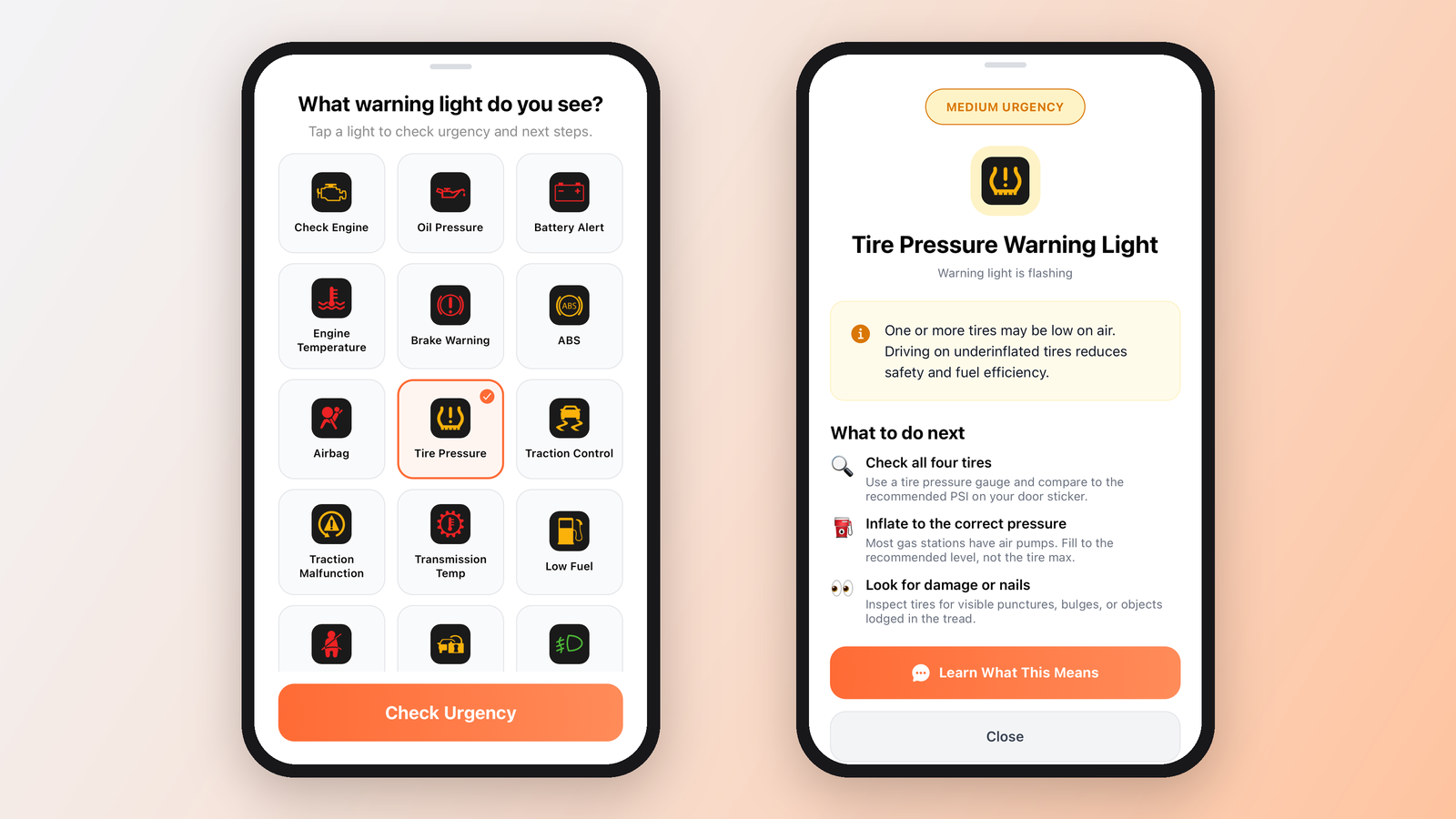
In AutoDex AI, a sheet asks, "What warning light do you see?" Tap a light from the grid, from check engine and oil pressure to ABS, airbag and low fuel, then tap Check Urgency.
For a flashing tire pressure light, the result reads Medium Urgency, with three next steps:
- Check all four tires with a gauge and compare them to the recommended PSI on the door sticker.
- Inflate to the correct pressure, which is the recommended level, not the tire's maximum.
- Look for damage or nails, such as punctures, bulges or objects in the tread.
Tap Learn What This Means and the conversation continues in chat, using your vehicle and its Logbook history. In one example, for a performance coupe whose Logbook showed recently replaced tires, the AI summary was marked Medium Confidence. It identified the pattern as a TPMS activation pointing to low pressure or a system fault, and listed possible causes: a puncture, a slow leak, seasonal temperature changes or a damaged sensor. The impact assessment: "Drive with caution. Check soon."
If a strange sound comes with the light, AutoDex Sound Diagnostics can record it and return a finding. AutoDex guidance is not a substitute for a licensed mechanic.
Make it a habit
When a light comes on, note its color, whether it's steady or flashing, and what the car was doing. For fleet managers, asking drivers to report those three details turns a vague complaint into a useful service ticket.
A warning light is a message, not a verdict. Read the color, notice whether it's steady or flashing, check your owner's manual and act on the urgency it signals.
Sources
- Consumer Reports, "What the Dashboard Warning Lights Mean in Your Car"
- AAA Club Alliance, "A Warning-Light Road Map"
- AAA Mid States, "Vehicle Warning Lights"
- Car and Driver, "Dashboard Warning Lights Explained"
- 49 CFR 571.138, FMVSS No. 138, "Tire pressure monitoring systems" (NHTSA; via Cornell LII)
- Honda, 2023 HR-V Owner's Manual, "Indicators"
- Honda, 2023 Accord Owner's Manual, "If the Brake System Indicator (Red) Comes On or Blinks"
- Kia, 2026 Owner's Manual, "Air bag warning light"
Tags: dashboard warning lights, car diagnostics, car maintenance, check engine light, brakes
Continue on the desk
- Check Engine Light: What Steady vs. Flashing Means and What to Do
- AutoDex Sound Diagnostics: Record a Car Noise, Get a Read
AI car diagnostics · Vehicle history and VIN lookup · Digital Maintenance Vault · Car expense and cost tracker · Plans and pricing