Gas Is Headed for a Record October. Habits That Actually Save Fuel
Gas averaged $4.27 on Oct. 22, up from about $3.07 a year ago, per AAA. These fuel-saving habits are backed by federal testing, not gas-station myths.
By AutoDex Team, Newsroom · 2026-10-27
Gas prices have eased a little this month, but not enough to change the big picture. The national average for regular was $4.27 a gallon on Oct. 22, down 6 cents from a week earlier but up from about $3.07 a year ago, according to AAA. AAA says October is on track to be the most expensive October on record, after record-setting months in August and September.
You can't control the price on the sign. You can control how much of it you burn. Here's what's driving prices and which fuel-saving habits hold up in testing.
Why prices are still high
The recent dip comes mostly from the seasonal switch to winter-blend gasoline, which is cheaper to make, AAA says. Crude oil is keeping a floor under pump prices. U.S. benchmark crude settled at $97.15 a barrel on Oct. 21, and AAA points to instability in the Strait of Hormuz.
The records are piling up. September averaged $4.33 a gallon, 50 cents above the previous September record set in 2023, according to AAA. And this is the first year the national average has topped $4 in October, AAA reported Oct. 8.
Where you live matters a lot. On Oct. 22, California averaged $6.08 and North Carolina $3.55, per AAA.
Diesel is worse. The national average was $6.31 on Oct. 20, about $2.70 more than a year earlier and down from a record $6.52 on Sept. 22, AL.com reported, citing AAA. For fleets running diesel vans and trucks, that gap adds up fast. Automakers are noticing, too: GM plans to add hybrids across several segments as fuel costs push up demand, CBT News reported.

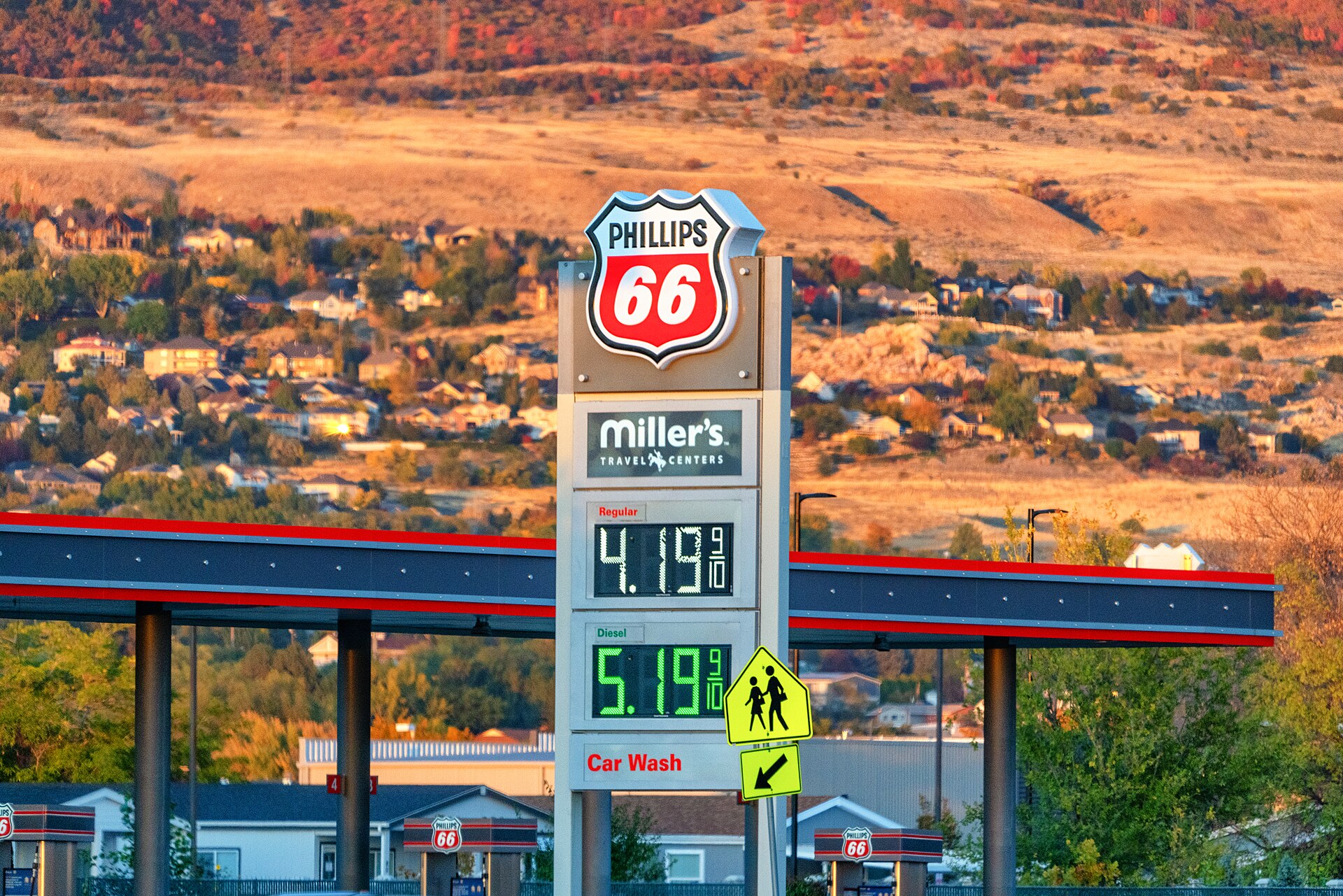
Posted prices at a gas station on Easter Sunday 2026. Photo: Rick Obst, via Wikimedia Commons (CC BY 4.0).
Drive smoother. It's the biggest lever
Speeding, hard acceleration and hard braking waste gas. Aggressive driving can lower your mileage by roughly 15% to 30% at highway speeds and 10% to 40% in stop-and-go traffic, according to FuelEconomy.gov, the joint Department of Energy and EPA site.
- Ease off the gas and brake. Look ahead, leave space and coast toward red lights instead of rushing up to them.
- Watch your highway speed. Mileage usually drops quickly above 50 mph. FuelEconomy.gov estimates that each 5 mph over 50 is like paying about 30 cents more per gallon, and that slowing down 5 to 10 mph can improve fuel economy by 7% to 14%. Your car's sweet spot will vary.
- Use cruise control on the highway. Holding a steady speed saves gas in most cases, the site says.
Smoother driving is also safer, which may be the bigger payoff.
Cut the drag and the dead weight
- Take the roof box off when you're not using it. A large rooftop cargo box can cut fuel economy by 6% to 17% on the highway and 10% to 25% at 65 to 75 mph, according to FuelEconomy.gov. A rear-mounted carrier costs much less.
- Clear out the trunk. An extra 100 pounds can reduce mileage by about 1%. Smaller cars feel it more.
Stop idling, and combine trips
Idling can burn a quarter to a half gallon of fuel an hour, depending on the engine and whether the AC is on. Restarting a warm engine takes only about 10 seconds' worth of fuel, according to FuelEconomy.gov. If you're parked and waiting more than a minute, turning the engine off generally saves money, as long as you aren't starting the car more than about 10 times a day. The site says that start limit doesn't apply to cars with automatic start-stop systems.
Short trips are expensive, too. An engine is least efficient when it's cold, so several short trips from a cold start can use twice as much fuel as one longer trip covering the same distance, the site's trip planning guide says. Run errands in one loop, and share rides when you can.
That matters more as temperatures drop. In city driving, a gasoline car's mileage is roughly 15% lower at 20°F than at 77°F, and up to 24% lower on short trips, according to FuelEconomy.gov. Skip the long warm-up. Most manufacturers recommend driving off gently after about 30 seconds.
Keep the basics in shape
- Check tire pressure monthly. Proper inflation improves mileage by about 0.6% on average and up to 3% in some cases. You lose about 0.2% for every 1 psi drop across all four tires, per FuelEconomy.gov. Use the pressure on the sticker in the driver's door jamb, not the maximum printed on the tire. Cold weather lowers pressure, so check more often this time of year.
- Use the oil grade your manual specifies. The wrong viscosity can cost 1% to 2% in fuel economy.
- Don't ignore the check engine light. A problem can quietly hurt mileage while the car seems to drive fine. Have a mechanic take a look.
Skip the myths
Premium fuel in a car built for regular. AAA's lab testing found no benefit in horsepower, fuel economy or emissions, and estimated drivers wasted more than $2.1 billion in a year on premium they didn't need, according to AAA. If your car says premium is required, use it. If it only says "recommended," AAA's follow-up research found small mileage gains that didn't make up for the higher price.
A new air filter for better mileage. On modern fuel-injected cars, replacing a clogged air filter can improve acceleration but doesn't improve fuel economy, FuelEconomy.gov says. Replace it on schedule, but don't expect savings at the pump.
Track what you spend
You can't tell whether a habit is working unless you measure it. Write down the odometer reading and gallons each time you fill up. Divide the miles since your last fill-up by the gallons you just bought, and you have your real-world mpg. A sudden drop with no change in how you drive is worth a look by a mechanic.
Feedback helps. Drivers who use feedback devices to save fuel improved mileage by about 10% in one study cited by FuelEconomy.gov. If you use AutoDex, you can log each fill-up in the Logbook, and Insights shows fuel spending next to repairs and maintenance. That makes it easier to see what the car really costs you each month. AutoDex also handles multiple vehicles, so a household or small fleet can keep every vehicle's fuel spending in one place.
The price on the sign will move on its own. These habits pay off either way.
Cover photo: Tony Webster, via Wikimedia Commons (CC BY 2.0).
Sources
- AAA: National Average Falls 6 Cents, But Crude Oil Nears $100/Barrel (Oct. 22, 2026)
- AAA: National Average Dips Following Record-Setting September (Oct. 1, 2026)
- AAA: Pump Prices Remain at Record Highs for Autumn (Oct. 8, 2026)
- AL.com: Gas prices for 10/20/26: Diesel prices up despite President Trump's executive order
- CBT News: Weekly roundup, Oct. 24, 2026
- FuelEconomy.gov: Driving More Efficiently
- FuelEconomy.gov: Keeping Your Vehicle in Shape
- FuelEconomy.gov: Planning and Combining Trips
- FuelEconomy.gov: Fuel Economy in Cold Weather
- AAA: U.S. Drivers Waste $2.1 Billion Annually on Premium Gasoline (2016)
- AAA: Premium Fuel Phase II Research Report (2017)
Tags: gas prices, fuel economy, ownership costs, tire pressure, car maintenance
Continue on the desk
- Car Maintenance Prices Are Up 7.8%. How to Keep Up Without Overpaying
- How to Keep Every Service Record With the AutoDex Logbook
- Check Engine Light: What Steady vs. Flashing Means and What to Do
- How Often Should You Really Change Your Oil?
- Tire Tread: The Penny Test and When to Replace Your Tires
- Should You Buy a Used EV? What to Check First
AI car diagnostics · Vehicle history and VIN lookup · Digital Maintenance Vault · Car expense and cost tracker · Plans and pricing