Tesla Shows Thruster-Boosted Roadster, Targets 2028 Production
Tesla's second-gen Roadster debuted with SpaceX cold-gas thrusters and a claimed sub-1-second 0-60 mph time. Musk targets 2028 production; no price yet.
By AutoDex Team, Newsroom · 2026-10-15
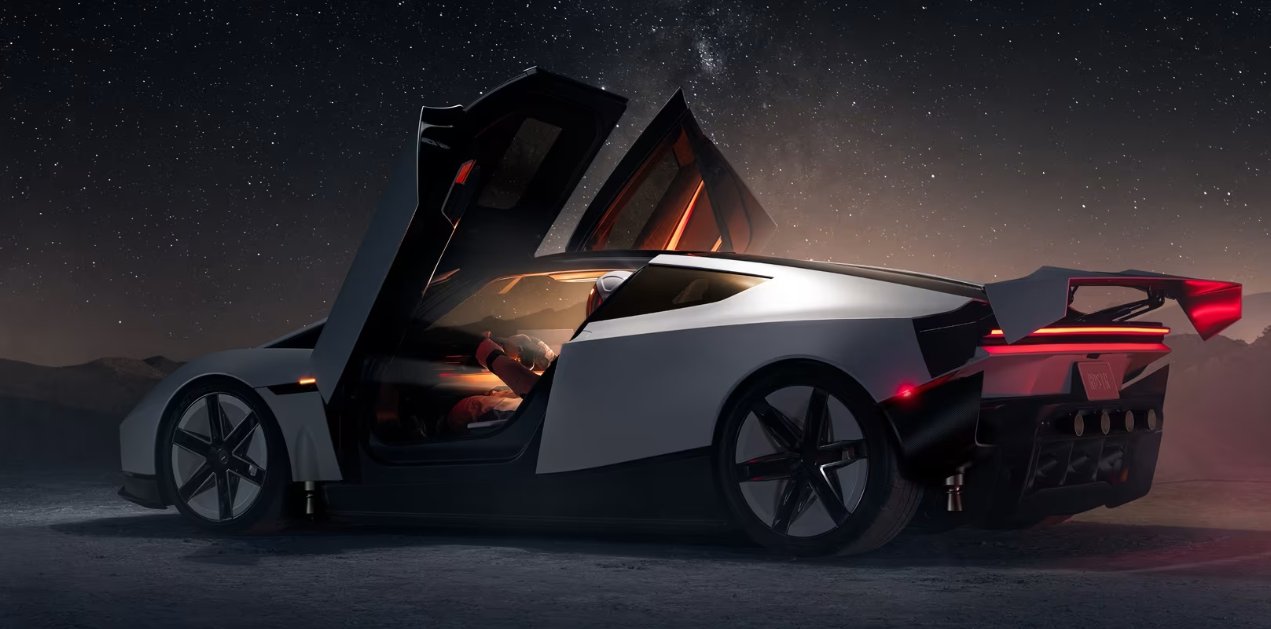
Tesla finally put its second-generation Roadster in front of an audience on Thursday night, nearly nine years after it first showed the car and promised deliveries in 2020. The livestreamed event at SpaceX's test site in McGregor, Texas, near Waco, was built around one idea: a sports car that uses SpaceX cold-gas thrusters to go faster than its tires allow, and briefly leave the ground.
Elon Musk said Tesla will build the car in 2028. He did not give a price.
What Tesla actually demonstrated
The show was a stunt demo on a closed site, not a drive event. According to TechCrunch and Engadget's live coverage, the white Roadster:
- Drove up a curved ramp until it was upside down, held there for a few seconds, then spun off and used its fans and thrusters to ease itself down to the pavement.
- Used its thrusters to lift itself over a row of Tesla vehicles (TechCrunch lists a Cybercab, Cybertruck, Semi, Model Y and Model 3) while moving, then landed again.
- Ran two 0-60 mph launches. The first took a claimed one second; after Musk was reminded he had promised under one second, the second was clocked at a claimed 0.81 seconds, Car and Driver reported. "We anticipate being able to do better than that," Musk said, per Engadget.
An Optimus humanoid robot sat in the driver's seat. Engadget's reporters said Tesla suggested the robot was there for show and that the car was programmed to perform the maneuvers. Tesla staff specified that no people were in the cars used for the demos, Jalopnik reported. Car and Driver noted that the stunt prototype wore different wheels from the car shown on stage.
So, is it a flying car? Tesla says one version is. Its post on X describing the trims says the top "Rocket" configuration "can fly." What the crowd saw was short, thruster-assisted hops and controlled descents. During one hop, Tesla's livestream showed an on-screen altitude readout of 51.2 feet; that is Tesla's own graphic, not an independently verified measurement. Tesla gave no figures for flight time or how many maneuvers one charge of air allows. Engadget's Aaron Souppouris summed it up with a Toy Story line: "That's not flying, that's falling with style."
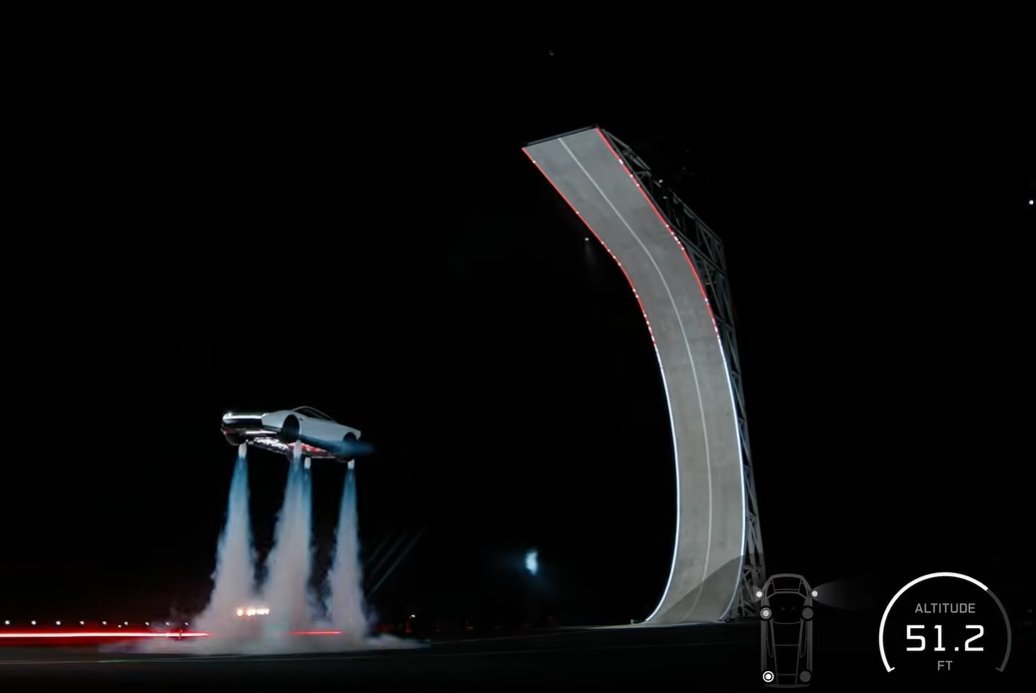
A thruster hop during the livestream; Tesla's on-screen readout showed 51.2 feet. Image: Tesla
How the thrusters work, according to Tesla
Lars Moravy, Tesla's vice president of vehicle engineering, said the car uses 10 nozzles fed by 600 liters of compressed air, and that the air tank can be recharged, TechCrunch reported. That describes the full Rocket setup. MotorTrend, which saw the car the day before the event, reports that the Thrust version uses a single 200-liter tank feeding four rear nozzles, while Rocket adds a second tank (600 liters total) and six more nozzles for lift and steering. Musk said owners will not need a "special propellant" to repeat the maneuvers.
On X, Tesla said "every usable void in the car" is packed with carbon-fiber overwrapped pressure vessels (COPVs) and that more compressed gas on board means more flight time. COPVs are the type of pressure vessel SpaceX uses on its rockets, TechCrunch noted. Tesla also claimed the thruster system produces four to five times the force the tires can, which is how it gets past the grip limit that caps every other road car's acceleration.
The other big trick is a fan-and-seal system that pulls air from under the car. Tesla's Roadster page says it creates enough suction to hold the car upside down even when stationary, and produces "massive downforce at zero speed."
Three versions, three very different cars
Tesla listed three configurations on X shortly after the event. All figures below are Tesla's own; none have been independently tested.
- Performance: "road ready," two seats, active aerodynamics and the suction system, no thrusters. Tesla says 0-60 mph in under 1.6 seconds. Tesla's site labels it "By Reservation."
- Thrust: "race ready," two seats, rear-mounted cold-gas thrusters. Tesla says 0-60 mph in under 0.9 seconds. The site labels it "Limited Release."
- Rocket: "air ready," one seat, thrusters around the whole car for forward, upward and rotational movement. Tesla says 0-60 mph in under 0.59 seconds. The site labels it "Invite Only," notes it is "not approved for public road use" and says it won't be offered in every region.
Tesla said a launch on stage hit 60 mph in 0.81 seconds, according to Engadget's live blog. Tesla didn't say which version made the run, though Road & Track and Jalopnik both say it appears to have been the rear-thruster Thrust setup. CNBC attributed the time to Tesla's own timer, Jalopnik noted that no timer was shown on screen during the run, and no independent testing has happened yet.
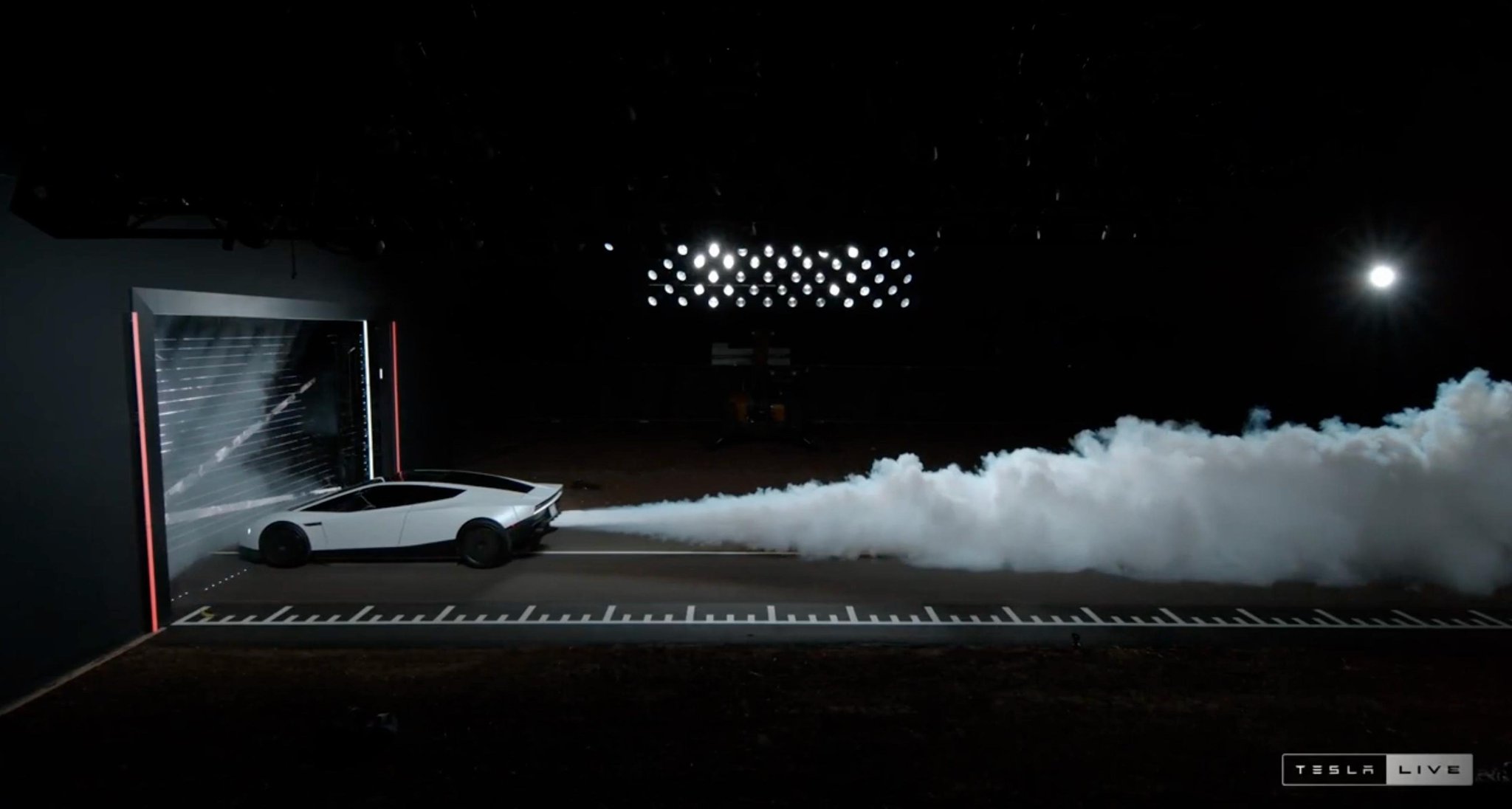
A thruster-assisted launch shown on Tesla's livestream. Image: Tesla
Tesla quotes range of more than 300 miles and a top speed of more than 230 mph for the Rocket version. It did not say which version the range figure applies to, and it gave no battery size, weight or horsepower on stage. In its pre-event briefing, MotorTrend reports, Tesla described two rear motors making about one megawatt (roughly 1,500 hp), a target weight of 1,700 kg (3,748 lb), a battery of "substantially more than 100 kWh," 10-80% charging in 10-12 minutes and a Performance top speed above 210 mph. MotorTrend calls the car "a prototype with production intent," so treat those as targets. Asked about top speed on stage, Musk said it can go "much faster" than the 235 mph figure mentioned, Engadget reported. He also said Tesla wants to "crack halfway to the speed of sound," or roughly 380 mph, per The Verge.
Tesla also did not say whether its 0-60 times include the one-foot rollout that U.S. magazines usually subtract. Electrek's frame-by-frame look found the rear thrusters firing before the car began to move, which could matter for how the run was timed. Until someone outside Tesla puts timing gear on a customer car, every acceleration number here is a company figure, not a test result.
Design and cabin
The 2017 car's smooth curves are gone. Tesla says the new shape follows the angular language of the Cybertruck, Cybercab and Optimus and was inspired by the SR-71 and F-35 military jets. TechCrunch compared it to a Lamborghini and to the Lotus Esprit from The Spy Who Loved Me, a car Musk owns that was on display at the event.
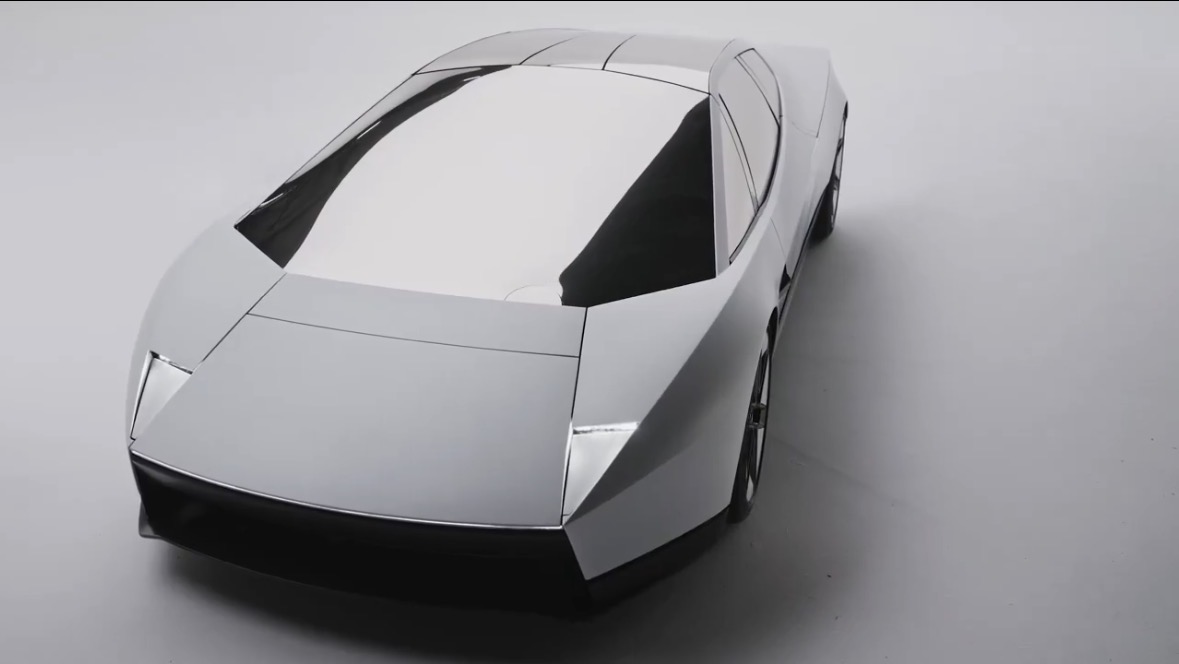
The new body trades the 2017 car's curves for sharp, faceted panels. Image: Tesla
According to Tesla's site, the car gets:
- Hidden headlights, a full-length taillight and flush-mounted aerodynamics.
- An "Ano White" paint inspired by aerospace coatings and gold-tinted glass.
- An "Ultrawhite" interior with gray microsuede, a fixed seat position and a yoke built for steer-by-wire.
- A center touchscreen plus two smaller forward displays.
- Magnesium, titanium and carbon fiber to cut weight.
- A Track Mode that lowers the car and transforms the suspension, with active wings moved by Optimus actuators. Tesla claims this is "the best passive downforce package of any road car."
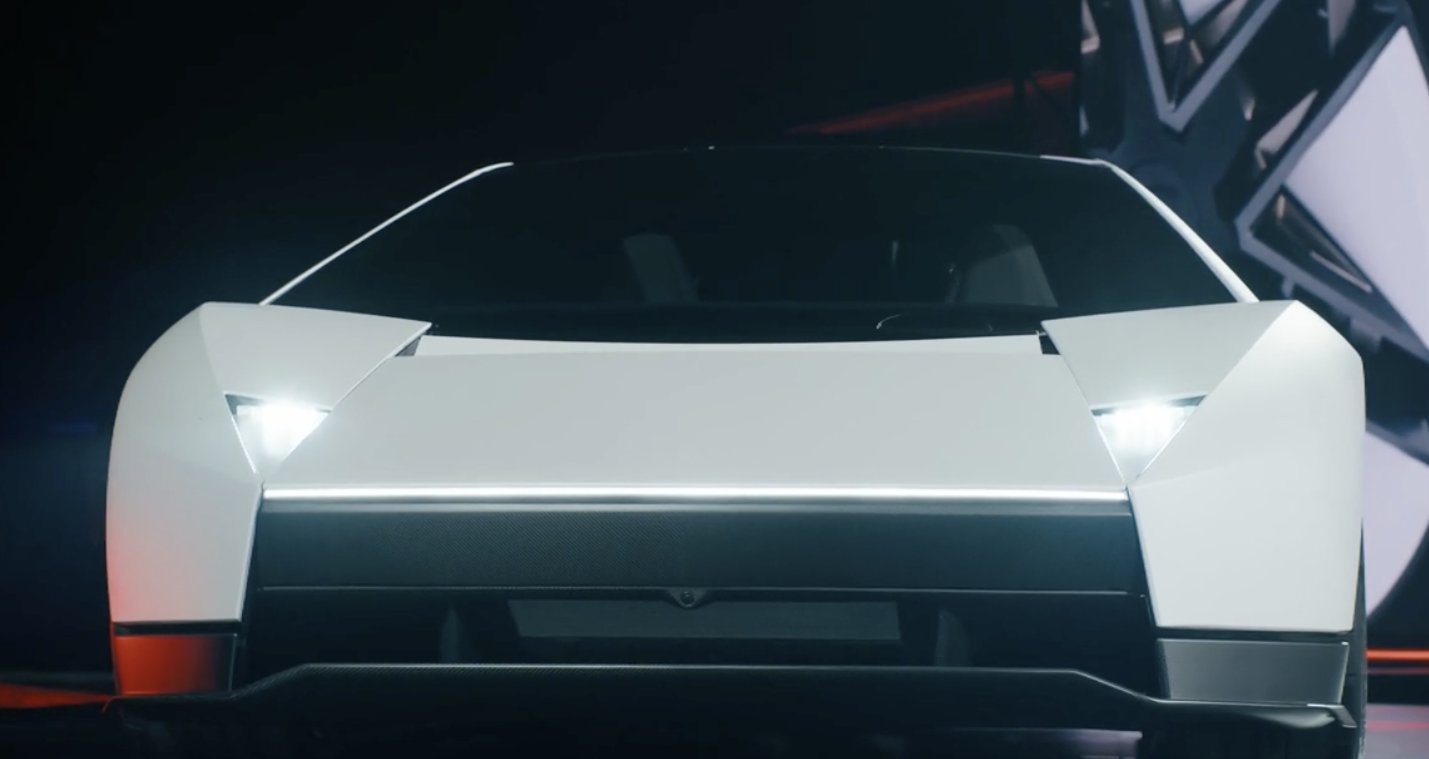
Angular hidden headlights sit above a full-width light bar. Image: Tesla
Musk was blunt about priorities. "This is not necessarily a safety-optimized car," he said on stage, per Engadget. He also said that "eventually" the Roadster will be the only Tesla built for human driving. On road use, he hedged: "I'm not sure it's necessarily legal in all jurisdictions, but there will be such a car that someone can own," per Car and Driver. Asked whether it would be street-legal, he said, "Depends on your street," Business Insider reported.
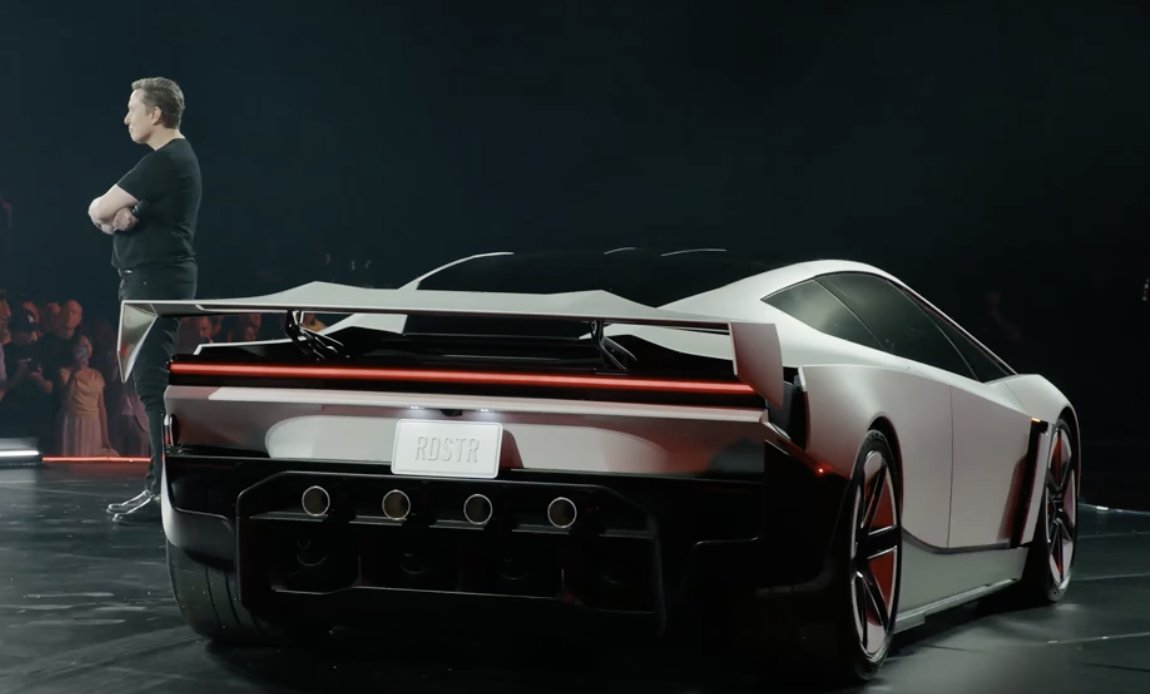
Musk with the Roadster on stage; he targets 2028 production. Image: Tesla
Price, reservations and timing
Tesla still hasn't announced a price. The reservation terms Tesla reopened last month are the most concrete numbers buyers have. Electrek reported that the deposit is $50,000: $5,000 on a card, described as fully refundable, then a $45,000 wire due within 10 days. CNBC said reservations are open in the U.S., Canada and China. After the event, Tesla's reservation page tied the $50,000 deposit to the Performance version and asked $250,000 to reserve a Thrust ($5,000 up front, then $245,000 within 10 days), according to Engadget and MotorTrend. Rocket is invite only. Business Insider notes that Tesla's reservation terms call those amounts estimates, say the final price will be confirmed closer to production, and state that Tesla "cannot guarantee when your vehicle will actually be delivered or if it will be delivered."
Musk's 2028 production target was the only timing given on stage. Tesla didn't name a start date within the year, a factory or a delivery schedule for each version, and it gave no update on what happens to reservations placed in 2017.
The track record
At the 2017 reveal, Tesla promised a four-seat Roadster with 0-60 mph in 1.9 seconds, 620 miles of range, a 200 kWh battery and a $200,000 base price, plus a $250,000 Founders Series, with production in 2020. Those were 2017 promises, not specs for the new car, and the 300-mile range quoted Thursday is about half the old figure.
Since then, by Electrek's count, production has slipped at least six times and the unveiling went through seven dates. Production was most recently guided for "2027 or 2028." The reveal itself was pushed from October 1; Tesla blamed the weather.
What it means for EV shoppers
For most drivers, the Roadster is a halo car, not a shopping decision. Musk himself has said he's "not sure it moves the needle massively from a revenue standpoint." The "road ready" Performance version is the one to watch. If it really pairs sub-1.6-second acceleration with daily usability, that would be news on its own. Thrusters, upside-down driving and road approval all still need to prove out outside a closed test site.
If you're shopping for an EV you can actually buy today, the basics haven't changed: battery health, warranty coverage, charging connector and real-world range. Our used EV buying checklist walks through each one.
Sources
- TechCrunch: Tesla reveals SpaceX-powered Roadster that flies and falls with style
- Engadget: Tesla Roadster reveal live blog
- CNBC: Tesla unveils long-delayed Roadster, showing off its flying-car ambitions
- Tesla: Roadster
- Tesla on X: Roadster configurations
- Tesla on X: Thrusters and pressure vessels
- Tesla on X: Thruster force versus tire grip
- Tesla on X: Design language
- Tesla on X: Track Mode
- The Verge: The Tesla Roadster flew, drove upside down, and hit 60mph in under a second
- Car and Driver: Revealed! New Tesla Roadster takes flight with SpaceX thrusters
- Jalopnik: Tesla Roadster re-reveal promises new design, flight, production in 2028
- MotorTrend: 2028 Tesla Roadster first look
- Road & Track: The air-assisted Tesla Roadster flies in demo, hits 0-60 in 0.8 seconds
- Engadget: Tesla's redesigned Roadster has a cold-gas thruster option, but you'll need $250,000 just to reserve it
- Business Insider: 3 fine-print disclaimers about the new flying Roadster
- Electrek: Are Tesla's claims for its new 'flying' Roadster real?
- Electrek: Tesla reopens $50,000 Roadster reservations
- Electrek: Tesla sets Roadster event for Thursday after nearly 9 years of delays
- Electrek: Tesla delays Roadster demo to October 15, blames weather
Tags: electric vehicles, tesla, sports cars
Continue on the desk
- Should You Buy a Used EV? What to Check First
- Average Car Age Hits a Record 12.9 Years: What It Means
- AutoDex Vehicle History Report: What's Inside and How to Use It
AI car diagnostics · Vehicle history and VIN lookup · Digital Maintenance Vault · Car expense and cost tracker · Plans and pricing